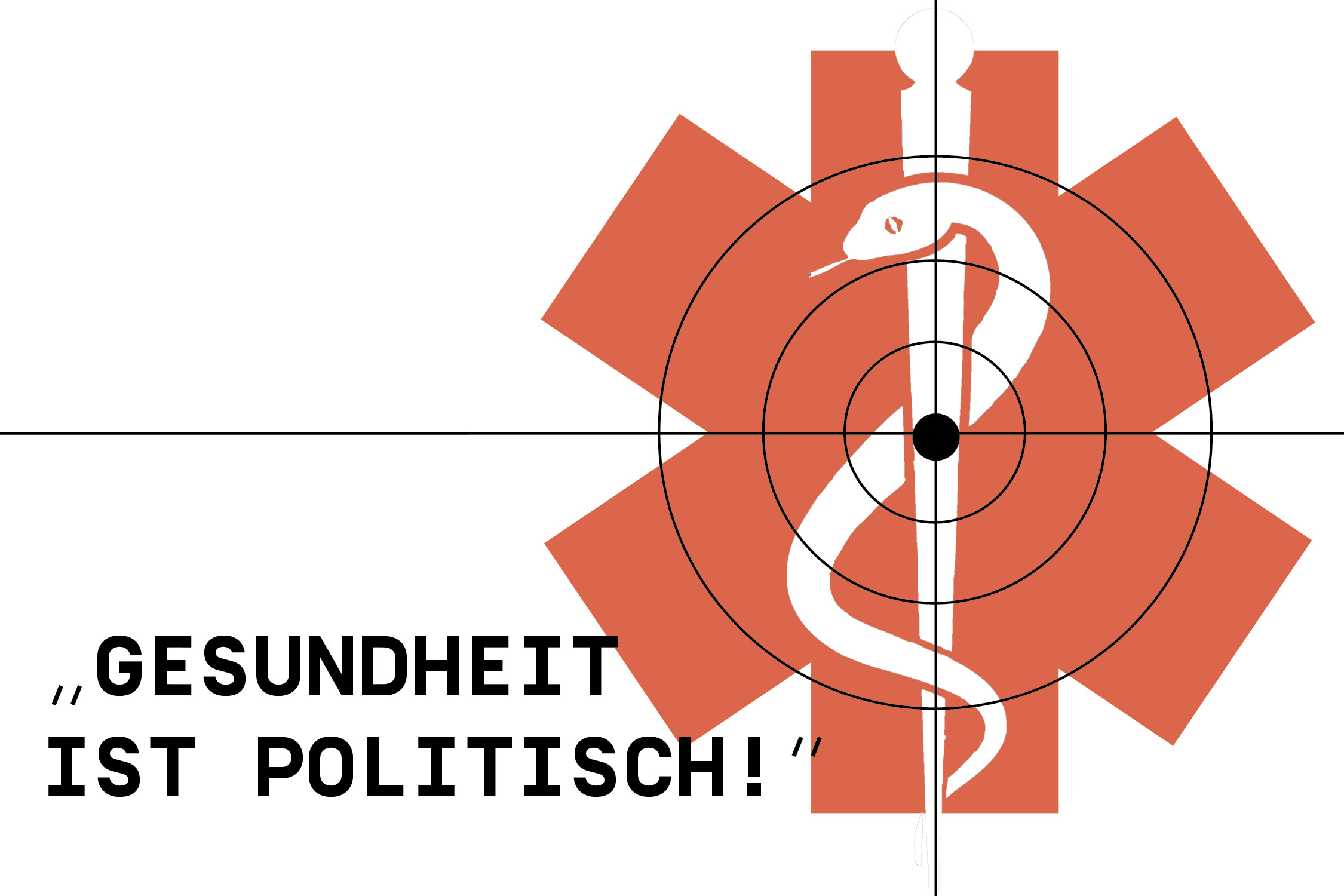
Dienstag, 17.03.2026 | Audimax | 15:30 bis 16:30 Uhr
Rechte Akteure stellen eine wachsende Bedrohung für
das Recht auf Gesundheit für Alle dar, sowohl global
als auch in Deutschland. Ein regelbasierter Multila-
teralismus zum Erreichen globaler Gesundheit wird von
ihnen ebenso infrage gestellt wie der Anspruch einer
Gesundheitsversorgung unabhängig von Leistungsprin-
zip oder ethnischen Zuschreibungen. Gemeinsam mit der
Deutschen Plattform für Globale Gesundheit analysieren
wir die Gesundheitspolitik der globalen Rechten und
fragen nach den Kontinuitäten und Brüchen mit der vor-
herrschenden neoliberalen Ordnung.
Es sprechen: Nadja Rakowitz (VDÄÄ) und Christopher
Knauth (DPGG) Moderation: Frauke Grundlach (IPPNW)
Kategorie: Aktuell
Defending the Right to Health // 14.10.2025 in Berlin
Panel Discussion at the Sidelines of the World Health Summit 2025

Tuesday, 14.10.2025 10:00 – 14:00
Venue: Staatsbibliothek Berlin, Simon Bolivar Saal, Potsdamer Str. 33, 10785 Berlin
Disruption and continuity sometimes occur simultaneously. This is very much the case when it comes to the state of global health in 2025. In many ways, the reduction in funding for global health programs and institutions in the wake of many countries‘ withdrawal from development aid—led by the US—is having a terrible impact on the health of people worldwide. An additional 600 deaths from AIDS per day is clear evidence that, for the global far right, not everyone is entitled to human rights such as the right to health. That is disruption.
The flip side of the coin is how societies deal with these attacks on the right to health. Here, there is a great deal of continuity. Already, 65% of health systems in Africa and Asia are privatized, and with the sudden funding gap, private companies are eagerly seeking new business opportunities. The promise of universal access to healthcare made by multilateral institutions and welfare states has never sounded so hollow to many as it does today.
For this reason, it is important that we put fingers in the wounds of global health in these days and discuss how the right to health is being threatened by both neoliberalism and right-wing extremism.
Program
09:30 Arrival, Coffee
10:00 Welcome note // Tsafrir Cohen, medico international
10:15 Key note: Health as a Battleground for the Far Right // Sophie Harman, Queen Mary University
11:00 Coffee Break
11:15 Panel: The War on Empathy and the Abolition of Health as a Social Right with Nadja Rakowitz (vdää*), Alexandrina Iovita (Global Fund) and Felix Stein (University of Amsterdam), Moderator: Victoria Saint (University Bielefeld)
13:00 Light Lunch
NO REGISTRATION NEEDED. In-person event only.
The conference hall is only accessible via stairs. If you need support with this, please let us know and we will find a solution.
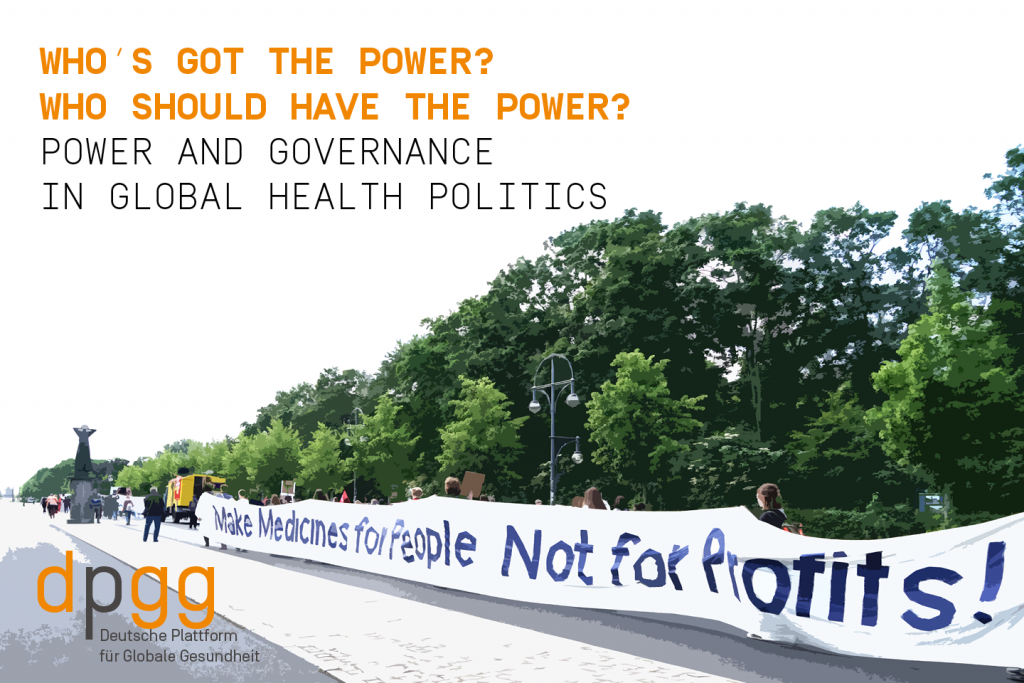
Who’s Got The Power? Who Should Have The Power? // 14.10.2024 Berlin
Power and Governance in Global Health Politics. Panel Discussions at the Sidelines of World Health Summit 2024

Monday, 14.10.2024
Start: 14:00
End: 19:00
Venue
Staatsbibliothek Berlin
Simon Bolivar Saal
Potsdamer Str. 33
10785 Berlin
Who has the power and who should have the power? These questions are of great importance for the state of global health but all too often receive little attention. This gap is also visible in the programme of the annual World Health Summit, which is taking place again in Berlin in October. We would therefore like to discuss these questions at a parallel event and look forward to welcoming you there.
Who has the power? Which health issues make it onto the agenda of the major institutions and conferences? Which players dominate the debates and what role do private sector actors play in shaping global health policies?
Who should have the power? In the second part of the event alternatives to the existing system will be presented: From overcoming intellectual property rights to factors such as debt cancellation and a just tax system.
Program
13:30
arrival, registration, coffee and brown bag lunch
14:00
Welcome, Introduction
Julia Stoffner, Bread for the World, DPGG
14:15
SESSION 1: 16 YEARS OF WORLD HEALTH SUMMIT – THE SECOND MOST IMPORTANT MEETING IN GLOBAL HEALTH?
Key Note: Power and Accountability in the Global Health Arena
Dave McCoy, UN University – International Institute for Global Health, Kuala Lumpur
Q+A, Discussion with audience
Moderator: Victoria Saint, Univer- sity of Bielefeld
15:30
coffee break, snacks
16:00
SESSION 2: WHO’S GOT THE POWER?
Equity in the Pandemic Treaty Negotiations
Pedro Alejandro Villarreal Lizárraga, German Institute for International and Security Affairs
The role of private finance Institutions – 30 years of neoliberal Reshaping of Global Health
Anna Marriott, Oxfam GB
Q+A , Discussion with audience
Moderator: Chris Knauth, Buko Pharmakampagne, DPGG
17:00
SESSION 3: CHALLENGING THE POWER
Public Pharma for Europe: Overcoming the Mantra of Intellectual Property as the Driver of Innovation and Access
Alan Silva, PHM Europe, Public Pharma for Europe
Freeing the money for public health: mobilizing for debt relief and just taxation
Bodo Ellmers, Global Policy Forum, DPGG
Q+A , Discussion with audience
Moderator: Frauke Heller, medico international , DPGG
18:00
wrap up, ways forward
Andreas Wulf, medico international, DPGG
18:10 – 19:00
reception, drinks, fingerfood
For better planning, please register for this side event via wulf@medico.de .
The conference hall is only accessible via stairs. If you need support with this, please note it in your registration and we will find a solution.
Global Care Chains: Die DPGG beim Equal Care Day
Facing growing shortages of health care workers, high- income countries like Germany tend to find the solution in international recruitment of health care personnel. This practise adds to the uneven distribution of health workforce globally, following economic imbalances. This panel aimed to put a spotlight on the recruitment of health workers from India to Germany, following the signing of an agreement by the German and Indian Government in 2021. We wanted to stimulate a discussion on the global dimension of Care equality.
With:
Felix Litschauer (Global health advocate at medico international)
and Karen Spannenkrebs (doctor, co-chair of the Association of Democratic Doctors)
and Santosh Mahindrakar (MSc Public Health, nurse, health activist)
and Christa Wichterich (sociologist and publicist)
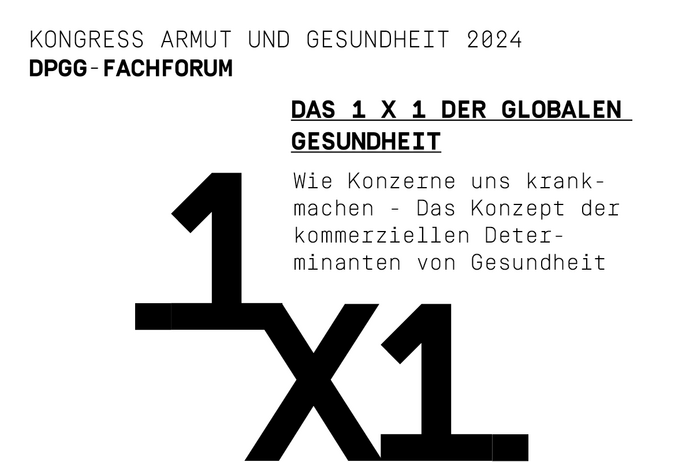
Das 1 x 1 der globalen Gesundheit // 06.03.2024 – 16:45 Uhr
Wie Konzerne uns krankmachen – Das Konzept der kommerziellen Determinanten von Gesundheit.
Fachforum der Deutschen Plattform für Globale Gesundheit auf dem Kongress Armut und Gesundheit.
Das Forum der Deutschen Plattform für Globale Gesundheit nimmt das System des globalisierten Marktfundamentalismus und dessen Akteure in den Blick. Schäden für die menschliche und planetare Gesundheit nehmen zu, ebenso die Gewinne von Unternehmen. Die Produkte und Praktiken von vier Industrien (Tabak-, Lebensmittel-, Alkohol- und fossile Industrie) sind für ein Drittel der Todesfälle weltweit verantwortlich. Inwiefern sind diese kommerziellen Faktoren mit sozialen Faktoren wie Armut verwoben und wie reproduzieren diese globale Ungleichheiten? Welche alternativen gesundheitsfördernden Konzepte und Praktiken sollten wir verfolgen? Diese und weitere Fragen wollen wir gemeinsam mit Aktivist:innen, Wissenschaftler: innen und Gewerkschafter:innen anhand von Beispielen aus der Nahrungsmittelindustrie erörtern.
Was sind kommerzielle Determinanten von Gesundheit?
Tim Dorlach, Universität Bayreuth
Gesundheitsschädliche Arbeitsbedingungen in der Nahrungsmittelproduktion
Benjamin Luig, DGB Beratungsnetzwerk Faire Mobilität
(Kinder)Marketing für ungesunde Lebensmittel
Jonas Schaffrath, VDÄÄ
Moderation:
Hélène Furaha Hauch, Institut für Allgemeinmedizin, Charité Berlin und
Dr. Andreas Wulf, medico international, Frankfurt
Anmeldung zum Kongress:
Paper of DPGG on international recruitment of health professionals
We call on the Federal Government to follow the guidelines of the WHO Code and to adopt
a sustainable national health personnel policy. Measures must be taken to increase the attractiveness of training and jobs in the health care professions and to help ensure that welltrained nursing professionals from Germany and abroad find future prospects here.
We call on the Federal Government to advocate for adequately financed, public welfare-oriented and needs-based health care systems in Germany and worldwide.
Documento de posición sobre la caza furtiva internacional de personal sanitario
Los ministros alemanes están de gira promocionando a los trabajadores sanitarios del Sur, mientras que en Alemania muchas enfermeras abandonan frustradas sus puestos de trabajo debido a las desastrosas condiciones laborales… La Plataforma Alemana para la Salud Mundial (DPGG) señala esta discrepancia en su nuevo documento de posición.
En él, la DPGG pide un replanteamiento fundamental para remediar la escasez de trabajadores cualificados en el sector sanitario: en lugar de apoyar la competencia economizada entre hospitales mediante la caza furtiva, se necesitan soluciones estructurales a la crisis del sector sanitario alemán. El objetivo debe ser aumentar el atractivo de la formación y los puestos de trabajo en las profesiones sanitarias y garantizar que los profesionales de enfermería bien formados de Alemania y el extranjero encuentren perspectivas de futuro en Alemania.
El DPGG es una alianza de actores de la ciencia, asociaciones sociales, sindicatos, activistas y ONG. Unieron sus fuerzas en 2015 bajo el lema „La salud mundial empieza en casa“. Con ello, el DPGG llama periódicamente la atención sobre las conexiones globales de la evolución de las políticas sanitarias nacionales.
Anwerbung, von der alle profitieren?
Webinar der Deutschen Plattform für Globale Gesundheit zur internationalen Abwerbung von Gesundheitsfachkräften am 29.06.2023, 17:00 Uhr
Vor dem Schreckensszenario eines deutschen Gesundheitssystems, das aufgrund von Personalmangel vor dem Kollaps steht, verspricht die internationale Abwerbung von Fachkräften eine Lösung zu sein. Seit Jahren bemüht sich die Bundesrepublik um Abwerbeabkommen in Ländern wie den Philippinen, Indien, Vietnam, aber auch Bosnien-Herzegowina und Serbien. Zuletzt reiste Bundesarbeitsminister Heil gemeinsam mit Außenministerin Baerbock nach Brasilien, um eine Absichtserklärung über eine „faire Anwerbung“ von Pflegekräften zu unterzeichnen, von der alle profitieren sollen.
Doch: Können durch die Anwerbung strukturelle Probleme des deutschen Gesundheitssystems tatsächlich gelöst werden? Wer profitiert tatsächlich durch die Anwerbungen und wer nicht? Was für Folgen haben solche Abwerbungen in den Herkunftsländern der Gesundheitsfachkräfte? Und wie ergeht es den neuen Kolleg*innen im kriselnden deutschen Gesundheitssystem?
Die Deutsche Plattform für Globale Gesundheit wirft einen kritischen Blick auf die Versprechen von Anwerbung, von der alle profitieren, und stellt ihr kürzlich veröffentlichtes Positionspapier vor.
Panel:
Dr. Tine Hanrieder, Assistant Professor in Health and International Development, London School of Economics and Political Science (LSE)
Santosh Mahindrakar, M.Sc. Public Health, People’s Health Movement India, Krankenpfleger am Uniklinikum Bielefeld
Karen Spannenkrebs, Ärztin, Verein demokratischer Ärzt*innen, Pillars of Health Projekt
Moderation: Felix Litschauer, medico international
Datum: 29.06.2023
Uhrzeit: 17:00 Uhr
Positionspapier zur internationalen Abwerbung von Gesundheitsfachkräften
Pünktlich zur parlamentarischen Debatte um das neue Fachkräfteeinwanderungsgesetz hat sich die DPGG zur Abwerbung von Gesundheitsfachkräften aus dem globalen Süden positioniert.
Die DPGG fordert ein grundlegendes Umdenken zu Behebung des Fachkräftemangels im Gesundheitswesen: Statt den ökonomisierten Wettbewerb zwischen den Krankenhäusern durch Abwerbung zu stützen braucht es strukturelle Lösungen für die Krise des deutschen Gesundheitssystems. Ziel muss es sein, die Attraktivität der Ausbildung und der Arbeitsplätze in den Gesundheitsberufen zu steigern und dafür zu sorgen, dass gut ausgebildete Fachpflegekräfte aus dem In- und Ausland in Deutschland eine Zukunftsperspektive finden.
Die Weltkrise ist immer auch eine Gesundheitskrise
Im Schatten der Pandemie. medico-Fachforum auf dem Kongress Armut und Gesundheit
Termin: Dienstag, 22.03.23, 13:15 – 14:45 Uhr
Ort: FU Berlin
Zuletzt hat die Covid-19-Pandemie die ungleiche Verteilung von Macht sowie soziale und wirtschaftliche Ausschlussmechanismen auf brutale, oft tödliche Weise offen gelegt. Es war unübersehbar: nicht einmal inmitten einer globalen Gesundheitskrise haben Politik und Wirtschaft ihr „business as usual“ in Frage gestellt – besonders sichtbar wurde dies an der Weigerung die Patente auf Impfstoffe freizugeben.
Doch schon vor dem Ausbruch der Pandemie war die Gesundheit weltweit in eine schwere Krise geraten. Privatisierung, Verschuldung, fehlende Ernährungssouveränität, Extraktivismus. Alle diese Faktoren sind eng verwoben mit dem kapitalistischen Wirtschaftssystem und trugen zur Verschlechterung der Gesundheit bei. Verbesserungen wie gestiegene Lebenserwartungen oder der Rückgang von HIV/Aids drohen durch die Folgen der Pandemie verloren zu gehen. Inmitten einer globalen Klimakrise und bedingt durch den Krieg in der Ukraine wird alles nur noch schlimmer.
Der alternative Gesundheitsreport Global Health Watch untersucht diese Faktoren und nennt Bedingungen, für die Gestaltung einer globalen Weltordnung, die das Menschenrecht auf Gesundheit ermöglichen würde. Zeit, mit den Autor:innen darüber zu sprechen.
Referent:innen
- Dr. Roman Rafael Vega Romero, Global Coordinator People’s Health Movement, Bogota, Columbia
- Dian Maria Blandina, People’s Health Movement Indonesia
Moderation
- Anne Jung, medico international, Frankfurt
Programm und Anmeldung unter
Defending the Right to Health // 14.10.2025 in Berlin
Panel Discussion at the Sidelines of the World Health Summit 2025

Tuesday, 14.10.2025 10:00 – 14:00
Venue: Staatsbibliothek Berlin, Simon Bolivar Saal, Potsdamer Str. 33, 10785 Berlin
Disruption and continuity sometimes occur simultaneously. This is very much the case when it comes to the state of global health in 2025. In many ways, the reduction in funding for global health programs and institutions in the wake of many countries‘ withdrawal from development aid—led by the US—is having a terrible impact on the health of people worldwide. An additional 600 deaths from AIDS per day is clear evidence that, for the global far right, not everyone is entitled to human rights such as the right to health. That is disruption.
The flip side of the coin is how societies deal with these attacks on the right to health. Here, there is a great deal of continuity. Already, 65% of health systems in Africa and Asia are privatized, and with the sudden funding gap, private companies are eagerly seeking new business opportunities. The promise of universal access to healthcare made by multilateral institutions and welfare states has never sounded so hollow to many as it does today.
For this reason, it is important that we put fingers in the wounds of global health in these days and discuss how the right to health is being threatened by both neoliberalism and right-wing extremism.
Program
09:30 Arrival, Coffee
10:00 Welcome note // Tsafrir Cohen, medico international
10:15 Key note: Health as a Battleground for the Far Right // Sophie Harman, Queen Mary University
11:00 Coffee Break
11:15 Panel: The War on Empathy and the Abolition of Health as a Social Right with Nadja Rakowitz (vdää*), Alexandrina Iovita (Global Fund) and Felix Stein (University of Amsterdam), Moderator: Victoria Saint (University Bielefeld)
13:00 Light Lunch
NO REGISTRATION NEEDED. In-person event only.
The conference hall is only accessible via stairs. If you need support with this, please let us know and we will find a solution.
Who’s Got The Power? Who Should Have The Power? // 14.10.2024 Berlin
Power and Governance in Global Health Politics. Panel Discussions at the Sidelines of World Health Summit 2024

Monday, 14.10.2024
Start: 14:00
End: 19:00
Venue
Staatsbibliothek Berlin
Simon Bolivar Saal
Potsdamer Str. 33
10785 Berlin
Who has the power and who should have the power? These questions are of great importance for the state of global health but all too often receive little attention. This gap is also visible in the programme of the annual World Health Summit, which is taking place again in Berlin in October. We would therefore like to discuss these questions at a parallel event and look forward to welcoming you there.
Who has the power? Which health issues make it onto the agenda of the major institutions and conferences? Which players dominate the debates and what role do private sector actors play in shaping global health policies?
Who should have the power? In the second part of the event alternatives to the existing system will be presented: From overcoming intellectual property rights to factors such as debt cancellation and a just tax system.
Program
| 13:30 | arrival, registration, coffee and brown bag lunch |
| 14:00 | Welcome, Introduction
Julia Stoffner, Bread for the World, DPGG |
| 14:15 | SESSION 1: 16 YEARS OF WORLD HEALTH SUMMIT – THE SECOND MOST IMPORTANT MEETING IN GLOBAL HEALTH?
Key Note: Power and Accountability in the Global Health Arena Q+A, Discussion with audience Moderator: Victoria Saint, Univer- sity of Bielefeld |
| 15:30 | coffee break, snacks |
| 16:00 | SESSION 2: WHO’S GOT THE POWER?
Equity in the Pandemic Treaty Negotiations The role of private finance Institutions – 30 years of neoliberal Reshaping of Global Health Q+A , Discussion with audience Moderator: Chris Knauth, Buko Pharmakampagne, DPGG |
| 17:00 | SESSION 3: CHALLENGING THE POWER
Public Pharma for Europe: Overcoming the Mantra of Intellectual Property as the Driver of Innovation and Access Freeing the money for public health: mobilizing for debt relief and just taxation Q+A , Discussion with audience Moderator: Frauke Heller, medico international , DPGG |
| 18:00 | wrap up, ways forward Andreas Wulf, medico international, DPGG |
| 18:10 – 19:00 | reception, drinks, fingerfood |
For better planning, please register for this side event via wulf@medico.de .
The conference hall is only accessible via stairs. If you need support with this, please note it in your registration and we will find a solution.
Global Care Chains: Die DPGG beim Equal Care Day
Facing growing shortages of health care workers, high- income countries like Germany tend to find the solution in international recruitment of health care personnel. This practise adds to the uneven distribution of health workforce globally, following economic imbalances. This panel aimed to put a spotlight on the recruitment of health workers from India to Germany, following the signing of an agreement by the German and Indian Government in 2021. We wanted to stimulate a discussion on the global dimension of Care equality.
With:
Felix Litschauer (Global health advocate at medico international)
and Karen Spannenkrebs (doctor, co-chair of the Association of Democratic Doctors)
and Santosh Mahindrakar (MSc Public Health, nurse, health activist)
and Christa Wichterich (sociologist and publicist)
Das 1 x 1 der globalen Gesundheit // 06.03.2024 – 16:45 Uhr
Wie Konzerne uns krankmachen – Das Konzept der kommerziellen Determinanten von Gesundheit.
Fachforum der Deutschen Plattform für Globale Gesundheit auf dem Kongress Armut und Gesundheit.
Das Forum der Deutschen Plattform für Globale Gesundheit nimmt das System des globalisierten Marktfundamentalismus und dessen Akteure in den Blick. Schäden für die menschliche und planetare Gesundheit nehmen zu, ebenso die Gewinne von Unternehmen. Die Produkte und Praktiken von vier Industrien (Tabak-, Lebensmittel-, Alkohol- und fossile Industrie) sind für ein Drittel der Todesfälle weltweit verantwortlich. Inwiefern sind diese kommerziellen Faktoren mit sozialen Faktoren wie Armut verwoben und wie reproduzieren diese globale Ungleichheiten? Welche alternativen gesundheitsfördernden Konzepte und Praktiken sollten wir verfolgen? Diese und weitere Fragen wollen wir gemeinsam mit Aktivist:innen, Wissenschaftler: innen und Gewerkschafter:innen anhand von Beispielen aus der Nahrungsmittelindustrie erörtern.
Was sind kommerzielle Determinanten von Gesundheit?
Tim Dorlach, Universität Bayreuth
Gesundheitsschädliche Arbeitsbedingungen in der Nahrungsmittelproduktion
Benjamin Luig, DGB Beratungsnetzwerk Faire Mobilität
(Kinder)Marketing für ungesunde Lebensmittel
Jonas Schaffrath, VDÄÄ
Moderation:
Hélène Furaha Hauch, Institut für Allgemeinmedizin, Charité Berlin und
Dr. Andreas Wulf, medico international, Frankfurt
Anmeldung zum Kongress:
Paper of DPGG on international recruitment of health professionals
We call on the Federal Government to follow the guidelines of the WHO Code and to adopt
a sustainable national health personnel policy. Measures must be taken to increase the attractiveness of training and jobs in the health care professions and to help ensure that welltrained nursing professionals from Germany and abroad find future prospects here.
We call on the Federal Government to advocate for adequately financed, public welfare-oriented and needs-based health care systems in Germany and worldwide.
Documento de posición sobre la caza furtiva internacional de personal sanitario
Los ministros alemanes están de gira promocionando a los trabajadores sanitarios del Sur, mientras que en Alemania muchas enfermeras abandonan frustradas sus puestos de trabajo debido a las desastrosas condiciones laborales… La Plataforma Alemana para la Salud Mundial (DPGG) señala esta discrepancia en su nuevo documento de posición.
En él, la DPGG pide un replanteamiento fundamental para remediar la escasez de trabajadores cualificados en el sector sanitario: en lugar de apoyar la competencia economizada entre hospitales mediante la caza furtiva, se necesitan soluciones estructurales a la crisis del sector sanitario alemán. El objetivo debe ser aumentar el atractivo de la formación y los puestos de trabajo en las profesiones sanitarias y garantizar que los profesionales de enfermería bien formados de Alemania y el extranjero encuentren perspectivas de futuro en Alemania.
El DPGG es una alianza de actores de la ciencia, asociaciones sociales, sindicatos, activistas y ONG. Unieron sus fuerzas en 2015 bajo el lema „La salud mundial empieza en casa“. Con ello, el DPGG llama periódicamente la atención sobre las conexiones globales de la evolución de las políticas sanitarias nacionales.
Anwerbung, von der alle profitieren?
Webinar der Deutschen Plattform für Globale Gesundheit zur internationalen Abwerbung von Gesundheitsfachkräften am 29.06.2023, 17:00 Uhr
Vor dem Schreckensszenario eines deutschen Gesundheitssystems, das aufgrund von Personalmangel vor dem Kollaps steht, verspricht die internationale Abwerbung von Fachkräften eine Lösung zu sein. Seit Jahren bemüht sich die Bundesrepublik um Abwerbeabkommen in Ländern wie den Philippinen, Indien, Vietnam, aber auch Bosnien-Herzegowina und Serbien. Zuletzt reiste Bundesarbeitsminister Heil gemeinsam mit Außenministerin Baerbock nach Brasilien, um eine Absichtserklärung über eine „faire Anwerbung“ von Pflegekräften zu unterzeichnen, von der alle profitieren sollen.
Doch: Können durch die Anwerbung strukturelle Probleme des deutschen Gesundheitssystems tatsächlich gelöst werden? Wer profitiert tatsächlich durch die Anwerbungen und wer nicht? Was für Folgen haben solche Abwerbungen in den Herkunftsländern der Gesundheitsfachkräfte? Und wie ergeht es den neuen Kolleg*innen im kriselnden deutschen Gesundheitssystem?
Die Deutsche Plattform für Globale Gesundheit wirft einen kritischen Blick auf die Versprechen von Anwerbung, von der alle profitieren, und stellt ihr kürzlich veröffentlichtes Positionspapier vor.
Panel:
Dr. Tine Hanrieder, Assistant Professor in Health and International Development, London School of Economics and Political Science (LSE)
Santosh Mahindrakar, M.Sc. Public Health, People’s Health Movement India, Krankenpfleger am Uniklinikum Bielefeld
Karen Spannenkrebs, Ärztin, Verein demokratischer Ärzt*innen, Pillars of Health Projekt
Moderation: Felix Litschauer, medico international
Datum: 29.06.2023
Uhrzeit: 17:00 Uhr
Positionspapier zur internationalen Abwerbung von Gesundheitsfachkräften
Pünktlich zur parlamentarischen Debatte um das neue Fachkräfteeinwanderungsgesetz hat sich die DPGG zur Abwerbung von Gesundheitsfachkräften aus dem globalen Süden positioniert.
Die DPGG fordert ein grundlegendes Umdenken zu Behebung des Fachkräftemangels im Gesundheitswesen: Statt den ökonomisierten Wettbewerb zwischen den Krankenhäusern durch Abwerbung zu stützen braucht es strukturelle Lösungen für die Krise des deutschen Gesundheitssystems. Ziel muss es sein, die Attraktivität der Ausbildung und der Arbeitsplätze in den Gesundheitsberufen zu steigern und dafür zu sorgen, dass gut ausgebildete Fachpflegekräfte aus dem In- und Ausland in Deutschland eine Zukunftsperspektive finden.
Die Weltkrise ist immer auch eine Gesundheitskrise
Im Schatten der Pandemie. medico-Fachforum auf dem Kongress Armut und Gesundheit
Termin: Dienstag, 22.03.23, 13:15 – 14:45 Uhr
Ort: FU Berlin
Zuletzt hat die Covid-19-Pandemie die ungleiche Verteilung von Macht sowie soziale und wirtschaftliche Ausschlussmechanismen auf brutale, oft tödliche Weise offen gelegt. Es war unübersehbar: nicht einmal inmitten einer globalen Gesundheitskrise haben Politik und Wirtschaft ihr „business as usual“ in Frage gestellt – besonders sichtbar wurde dies an der Weigerung die Patente auf Impfstoffe freizugeben.
Doch schon vor dem Ausbruch der Pandemie war die Gesundheit weltweit in eine schwere Krise geraten. Privatisierung, Verschuldung, fehlende Ernährungssouveränität, Extraktivismus. Alle diese Faktoren sind eng verwoben mit dem kapitalistischen Wirtschaftssystem und trugen zur Verschlechterung der Gesundheit bei. Verbesserungen wie gestiegene Lebenserwartungen oder der Rückgang von HIV/Aids drohen durch die Folgen der Pandemie verloren zu gehen. Inmitten einer globalen Klimakrise und bedingt durch den Krieg in der Ukraine wird alles nur noch schlimmer.
Der alternative Gesundheitsreport Global Health Watch untersucht diese Faktoren und nennt Bedingungen, für die Gestaltung einer globalen Weltordnung, die das Menschenrecht auf Gesundheit ermöglichen würde. Zeit, mit den Autor:innen darüber zu sprechen.
Referent:innen
- Dr. Roman Rafael Vega Romero, Global Coordinator People’s Health Movement, Bogota, Columbia
- Dian Maria Blandina, People’s Health Movement Indonesia
Moderation
- Anne Jung, medico international, Frankfurt